
How to Build a Marketing Plan for Accounting Services
Most of the firm owners I talk to grew their practice on referrals. That works well for years, and then one season the referrals slow down, or they keep bringing in clients who don’t pay what the work is worth.
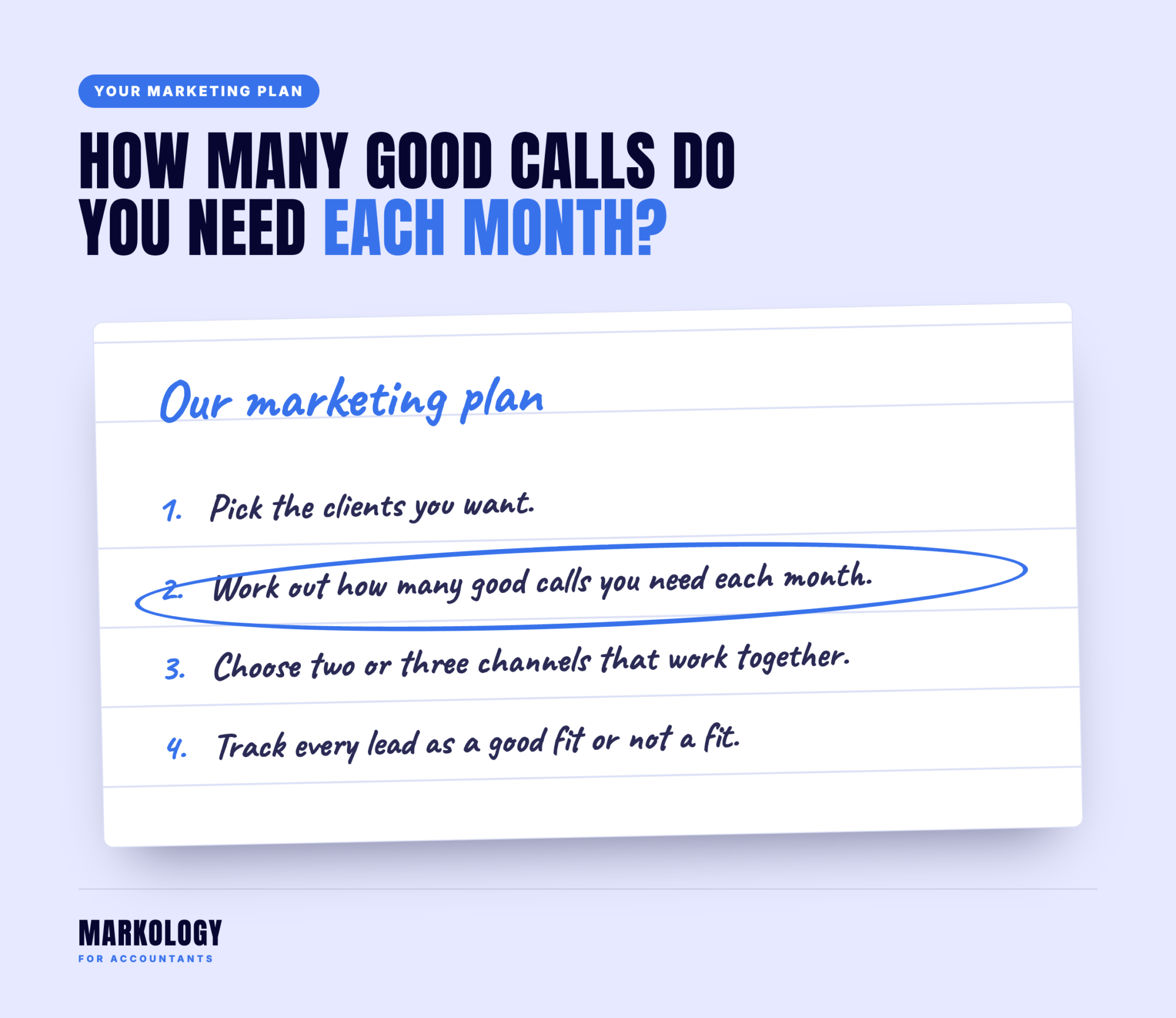
A marketing plan for accounting services helps with that by starting with the clients you want, not the channels. You decide who you want to serve, work out how many good-fit calls you need each month to hit your goal, and pick two or three ways to reach those people. Then you track every lead so you can see what’s working.
I run Markology, and we’ve spent more than seven years marketing accounting firms. This is the same order we follow when we build a plan for a new client.
Start With the Clients You Already Love
The first part of the plan is deciding who you want more of, because every other choice depends on it. Your website, your blogs and your ads all get easier to write once you know who they’re for.
A lot of firms tell me they serve everyone. When we look a little closer, there’s usually a handful of thrilled clients in one industry, like dental practices, therapists, restaurants or HVAC companies. That group is often your best starting point, because you already know their world and some of them will happily give you a review.
Be honest about the clients you don’t want, too. We have firms that are found for real estate searches and turn a lot of those leads away, because the clients turned out to be too chaotic for them.
If you’re not sure about a niche yet, test it before you rebuild the whole site. Add a page for that industry to your existing site, write a few blogs for it and run some ads to it for a quarter or two. If clients start coming in, you can build on it from there. We wrote more about this in our post on whether your accounting firm should niche.
How Many Calls Do You Need Each Month?
Once you know who you’re after, the next question is how much marketing you need. You can answer it with a little math that works backward from your goal.
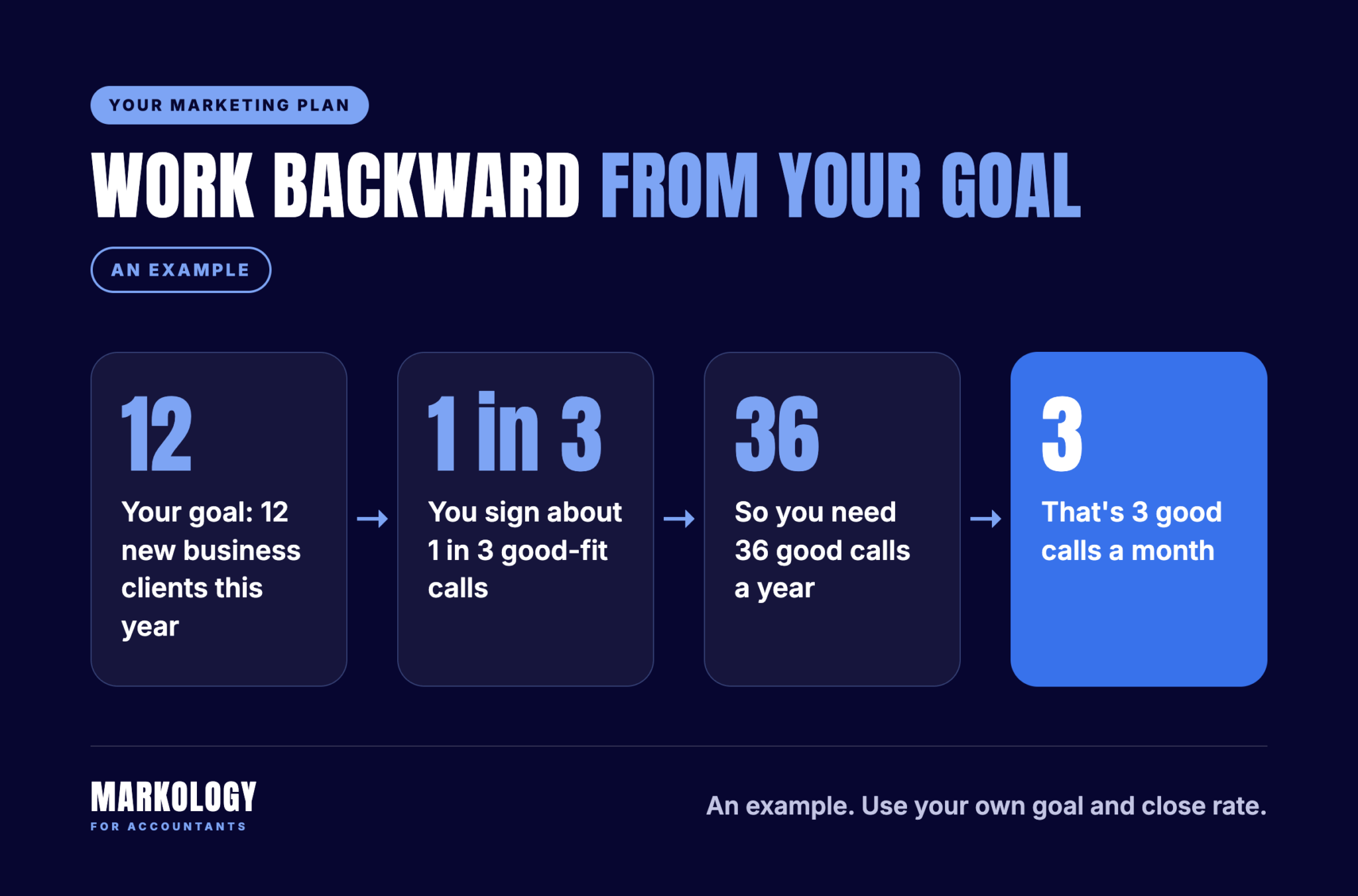
Say you’d like to add 12 new business clients this year. From experience, you know you sign about one out of every three good-fit calls you take. That means you need 36 good calls over the year, which works out to three a month.
Three calls a month is a very different plan from fifteen. A firm that needs three might get there with a strong website, a few blogs a month and a small ad budget. A firm that needs fifteen will probably need more than that, so the plan has to grow to match.
Use your own numbers here, even rough ones. Your close rate comes from your last year of calls, and your goal comes from the capacity your team actually has.
Pick a Few Channels That Work Together
With a monthly target in hand, you can choose how to reach those people. It’s tempting to try everything at once, but I’d start with two or three, so each one gets enough time and budget to show you whether it works.
The table below compares the main options for an accounting firm.
| Channel | What it does for you | How fast it works | What it needs from you |
|---|---|---|---|
| Referrals | Brings in people who already trust you | Hard to predict | Staying in touch with clients and partners |
| SEO (Google and AI search) | Gets your firm found when people search or ask ChatGPT | Builds over months | A website and blogs that answer real questions |
| Google Ads | Puts you in front of people searching right now | Faster than SEO | A monthly budget and a page that matches the search |
| Blogs and social | Shows prospects you know their industry | Builds over months | Your stories and opinions |
| Email follow-up | Keeps you in touch with people who aren’t ready yet | Ongoing | A short series for each service you offer |
SEO for accountants is the work of getting your pages found on Google and AI search, and it compounds the longer you do it. Accounting ads can bring in leads while that builds. SEO usually takes a few months to start bringing in leads, so ads are often what brings in the first calls.
The channels also need to back each other up. Your blogs should cover the same services your pages are built around, and your ads should send people to a page about what they searched for.
Make Sure Your Website Can Turn Visitors Into Calls
When someone does visit your website, booking a call should be the easiest thing to do there. More visitors won’t help much if the next step isn’t clear.
One of the first changes I’d make is putting a booking calendar right on the page, so a visitor can pick a time without any emails back and forth. After that, make sure each service and industry you want has its own page. A dentist who lands on a page about dental practices can see right away that you work with practices like theirs.
Not everyone is ready to talk on the first visit. When someone downloads a guide about payroll, the emails they get next should be about payroll too, like a payroll case study or a review from a payroll client. We set this up for firms as part of our accounting client lead funnels.
Even a well-built site needs a plan for the months when nobody at the firm has time to think about marketing, and for most firms those months are tax season.
Plan Around Tax Season
An accounting firm’s year has a busy season in the middle of it, and your plan needs to allow for that. I’ve had clients go almost completely hands-off from February to mid-April, and that’s fine, because they’re in survival mode.
The way around it is to have your blogs, social posts and emails written and scheduled before February. That way your marketing keeps going while you’re buried in returns.
Ads are a judgment call that depends on your firm. One of our clients gets more than enough leads during tax season, so we pause their Google Ads in season and turn them back on in late spring. Other clients choose to add budget in those months instead.
The weeks after the deadline are useful too. In May, some business owners have just paid a tax bill that surprised them, and that can be a good time to talk to them about planning for next year.
How Do You Know the Plan Is Working?
A plan is only useful if you can tell whether it’s paying off, and that means counting the right thing. Website visits and form fills are easy to count, but they don’t tell you much on their own.
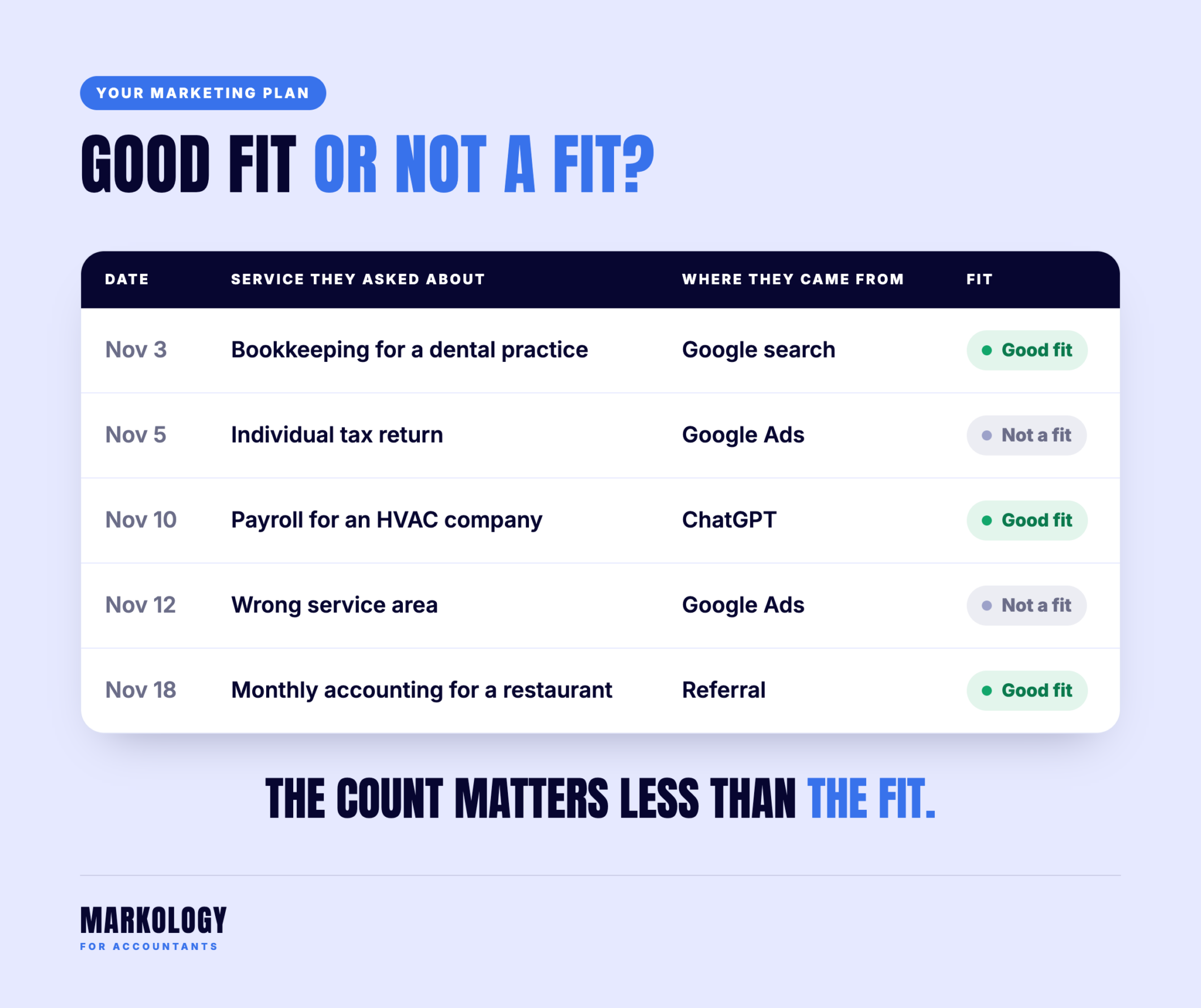
We set up a simple lead sheet for our clients that records each booking and where it came from. Then we go through it with them and mark each one as a good fit or not a fit. It sounds basic, but it’s one of the most useful things we do, because it tells us which channels bring in the clients you actually want.
The raw count can fool you. A busy month of form submissions can turn out to be mostly individuals when you were trying to win business clients. That’s why the number we watch is qualified business leads, along with organic traffic compared to the same month last year.
It also helps to keep search leads and ad leads separate. When ads are running while SEO builds, the ads will often bring in calls first, and if you can’t see the search side growing underneath, it’s easy to cut your SEO before it has time to pay off.
When the plan is working, the results show up in that sheet. A bookkeeping firm we work with that serves therapists went from 16 booked discovery calls in a quarter to 76 in a quarter. You can see a few more examples on our success stories page.
Frequently Asked Questions About Accounting Marketing Plans
How much should an accounting firm spend on marketing?
It depends on how many calls you need each month and how quickly you need them. A firm that needs a few more clients a year can spend far less than one trying to double. Our plans are listed on our pricing page, along with what each one includes.
How long does it take a marketing plan to bring in clients?
Ads can usually bring in calls sooner, since they don’t depend on your site building up over time. SEO and content take longer, often several months, because they build on each other over time. Every firm is different, so it’s worth tracking from the first month.
Do I need a niche to have a marketing plan?
You don’t need one, but a niche makes every part of the plan easier. If you’re not ready to pick an industry, start with your local area, where the competition in search is often lighter than it is nationally, and look at where your happiest clients already are.
Put Your Plan on One Page
If you only do one thing after reading this, write down how many good-fit calls you need each month and where you think they’ll come from. That one page gives you something to hold every marketing report up against.
We go deeper on each channel in our guide to marketing for accountants, and our post on how to choose an accounting firm marketing agency can help if you’d rather have someone run it for you.
If you’d like help building your plan, you can book a call with us here.
Until next time!