Advertising for Accounting Firms: Where to Start
A question we hear on a lot of first calls goes something like this: “We see other accountants running Facebook ads and it looks like it’s working. Should we be doing that instead of Google?”
Advertising for accounting firms usually works best when you start with Google search ads, because the person seeing your ad is already looking for an accountant. Facebook, Instagram and LinkedIn ads work when you have something to give people first, like a guide or a webinar. Whichever you choose, the ad should lead to a page built for it, and someone should be checking the leads that come in.
I’m Whitney, the founder of Markology. We only work with accounting firms and we run their ads every day, so this is how we’d think about your budget if you asked us on a call. The first decision is which channel gets your money first.
Why Google Ads Usually Come First
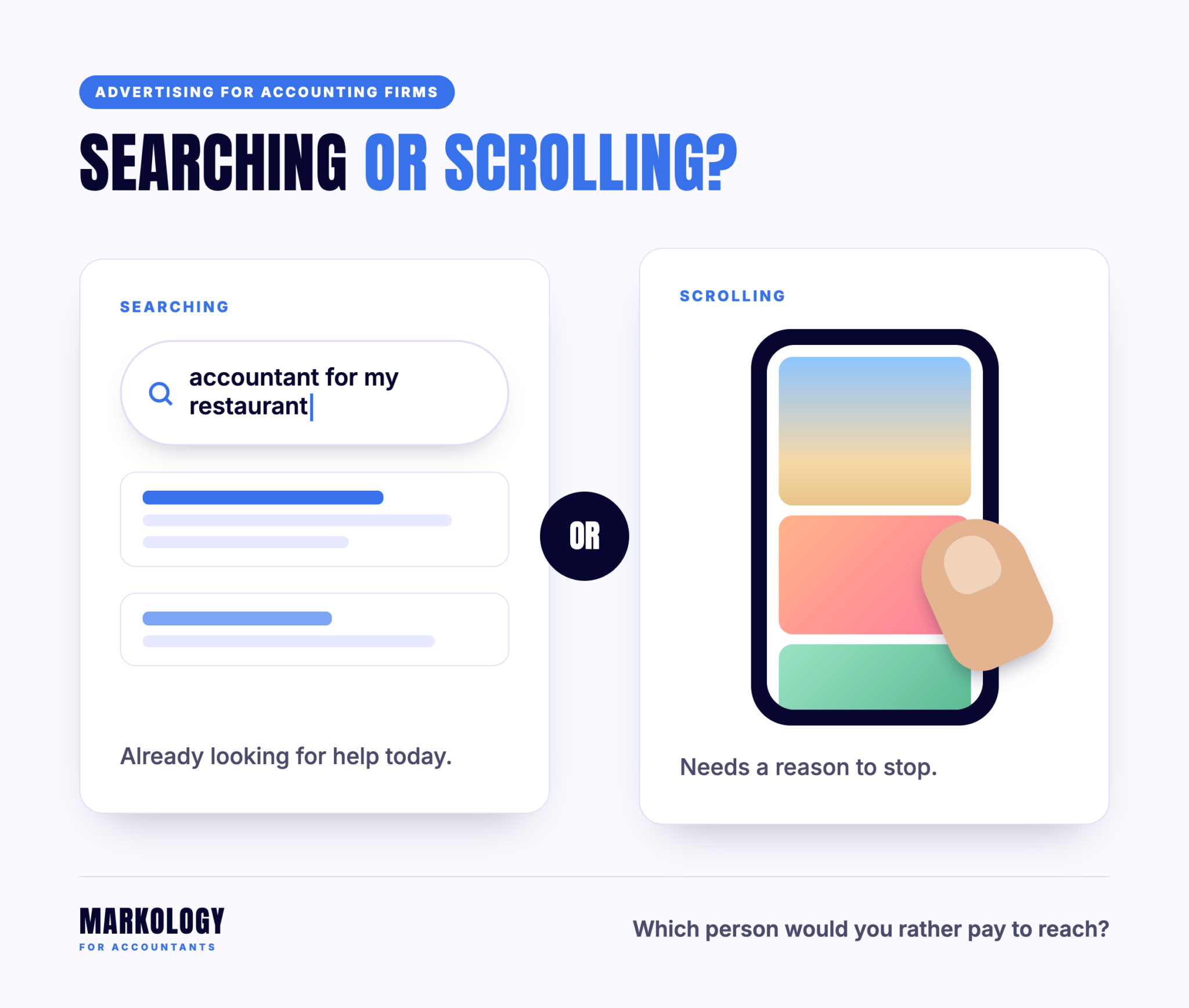
Google gets the first dollar for most firms because of what the person is doing when they see your ad. When someone types a search into Google, they’re actively looking for help. When they’re scrolling Instagram, they’re probably not in the mood to go and find a new accountant.
Google Ads also cover the gap while your SEO builds. SEO and content take time, and even a small Google Ads budget of around $150 a month can bring leads in the door while you wait for the organic side to kick in. Nobody should be sitting there twiddling their thumbs for six months.
That’s why we put it into our smallest plan. Markology LITE is $1,699 a month, month to month with no contract, and it includes $150 a month of Google Ads spend that we manage alongside your SEO and content.
Once the ads are running, the first number we watch is click-through rate, which is how often your ad gets clicked out of the times it’s shown. It tells you whether your message is landing before anyone reaches your site. For the accounting firms we work with, 3% is the floor and we want to see 4% to 5%. If you’re under that, the ad copy or the keyword targeting is usually the reason, and we fix that before adding budget.
When Do Facebook and LinkedIn Ads Work for an Accounting Firm?
Social ads are where a lot of firms start, because Facebook and Instagram clicks usually cost less than Google search clicks. We don’t usually recommend Facebook and Instagram ads as the first step, though. An ad that says “we’re an accounting firm, click through and learn about us” rarely converts when someone is scrolling.
The exception is when you have something to give them first. A webinar or a free guide works, because a person can hand over their email while they’re scrolling and you can follow up afterwards. Asking for the email also filters out a lot of the tire kickers, and you still go through the list to see which leads are a good fit.
A few things we’ve learned from running these for clients:
- A clear graphic with a specific headline has beaten video for us. When we’ve pulled the video and run a static graphic, the cost per lead has dropped.
- Each audience needs to see itself in the ad. Real estate brokers, mortgage brokers and insurance brokers are all “brokers”, and they still need separate ads that name them.
- The topic should be specific and timely. For our clients, a webinar on one tax change for one type of client has done better than a general ad about the firm.
LinkedIn follows the same rule, and it’s most useful when you want to reach one industry or job title. We compared the two biggest channels in more detail in our post on Facebook vs Google ads.
If you run more than one channel, match the offer and the page to what each ad is asking people to do. This is how we’d set them up.
| Channel | Who it reaches | What to offer | Where to send them |
|---|---|---|---|
| Google search ads | People searching for an accountant right now | A clear reason to book a call with you | A landing page that matches the search, with one way to book |
| Facebook and Instagram ads | People scrolling who aren’t looking for an accountant yet | A webinar or free guide in exchange for an email address | A short sign-up page, then follow-up emails |
| LinkedIn ads | One industry or job title you want to work with | A webinar or guide written for that audience | A sign-up page that names that audience |
| Retargeting ads | People who have already visited your site | A reminder and a reason to come back | The page they were on, or your booking page |
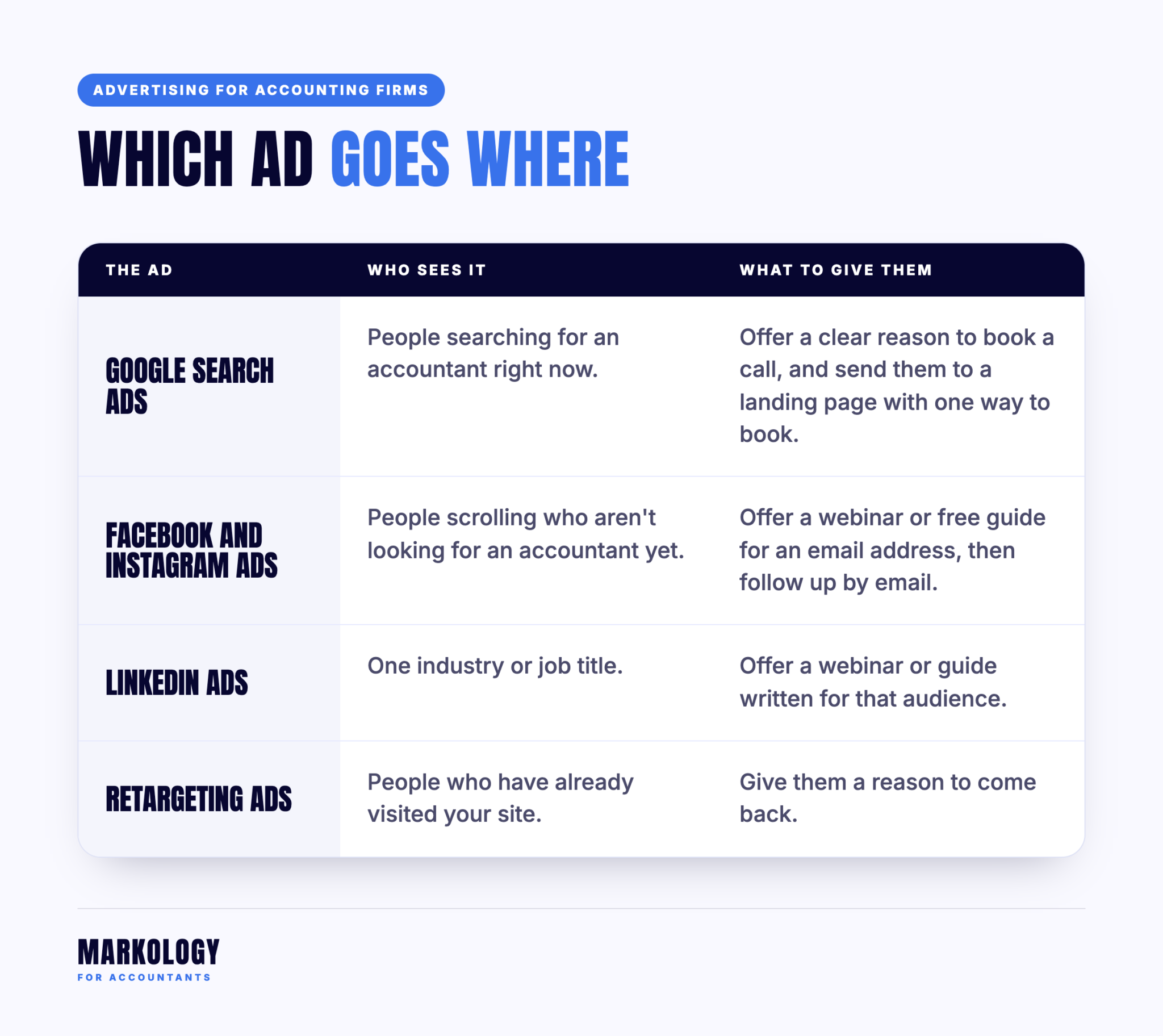
The last column matters because the page is where someone actually books or signs up.
The Page Your Ad Lands On Matters as Much as the Ad
Once someone clicks, the page they land on decides whether they book. Even a great ad struggles if it leads to a weak page. Sending ad traffic to your homepage usually loses people, because a homepage is built for exploring. A landing page has one message and one thing to do.
We had a client whose landing page converted so well that we turned it into their homepage. The whole page is built around one message, which is that they work with their clients all year. It has a stack of reviews and a single button, and it performs better than any traditional homepage we’ve run for them.
The page also has to match the keywords you’re running ads against. If the ad promises bookkeeping for restaurants, the page should say bookkeeping for restaurants in its first line. You can see how we build these on our accounting client lead funnels page.
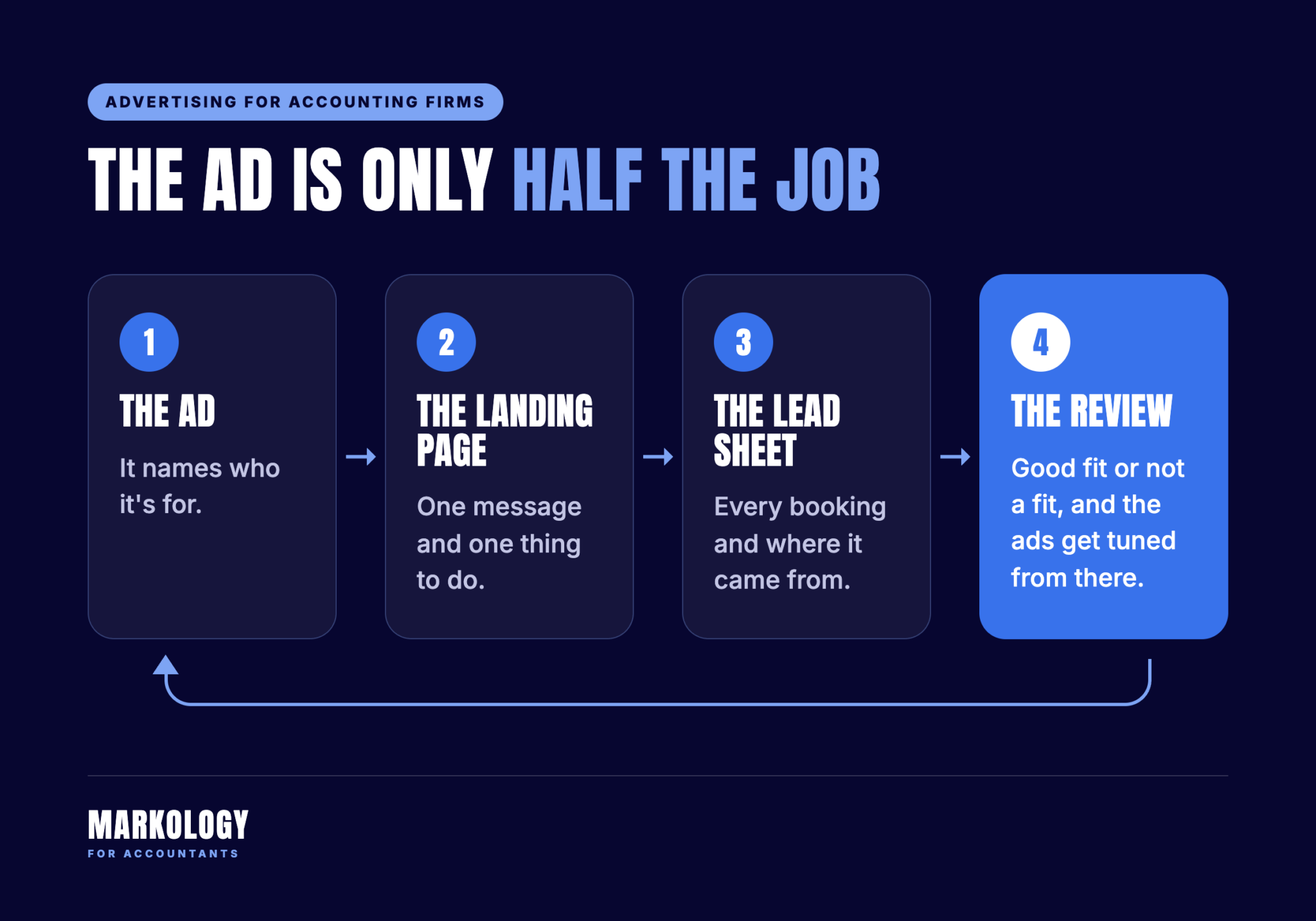
With the ad and the page in place, the next question is how much to put behind them.
How Much Should an Accounting Firm Spend on Ads, and When?
A budget doesn’t have to be big to be useful. We’ve seen around $3,000 to $4,000 for the year bring in a meaningful number of leads when the targeting and the ad copy were right.
It helps to know how the budget works. Google Ads works from an average daily budget, so spending goes up and down from day to day. If the budget is too small for the number of people searching in your area, your ads show less often, and you miss some of the people who would have clicked.
Before you raise the budget, check what you’re getting for it. We explain how to work that out in our post on CPA in digital marketing, which means cost per acquisition in this case.
When you spend matters as much as how much, because accounting is a seasonal business. In our experience, people start thinking about their accountant again in October, and demand builds from there into tax season. We like campaigns to be running before that window opens.
What you do in the season itself depends on your capacity. One firm we work with gets more than enough leads during tax season, so we pause their Google Ads in the fall and switch them back on in late spring. Other clients add a few hundred to a couple of thousand dollars during tax season to be seen while the most people are searching for tax help.
Early summer is slow for most of the firms we work with. Ads that did well in the first quarter can sit quiet in June. The season is one of the first things we check, before anyone rewrites the campaign.
What a Good Campaign Looks Like
A good campaign brings all of this together: an offer worth stopping for, a page that matches it, and someone checking the leads. One of our favorite examples is a campaign we built with The Fitness CPA around one timely tax topic. It used an interactive quiz, sharp ad creative and a fast launch, and it led to more than $1M in sales.
The quiz did the job a guide or a webinar does. It gave people a reason to stop, answer a few questions and hand over their details.
Most campaigns are smaller than that, and the routine behind them is the same. We set up a lead sheet that captures every booking and where it came from. Then we go through it with the client and mark each lead as a good fit or not a fit, and that feedback is how we tune the ads.
Frequently Asked Questions About Advertising for Accounting Firms
These are the three questions owners ask us most once the ads conversation gets going.
Do Google Ads work for accounting firms?
They do when the ads target what your ideal client searches for and lead to a page that matches. Ads can also be switched on quickly, which is why we use them while SEO is getting your firm found on Google and AI search.
Should an accounting firm run ads during tax season?
It depends on how full you are. If you can take on more clients, tax season is usually when the most people are searching for tax help. If your team is at capacity, pause the campaigns and keep them built, so you can switch them back on when things slow down.
Can we run ads without doing anything else?
You can, and if you need leads fast on a tight budget, a Google Ads specialist may be your best first move. We don’t run ads on their own, because ads work better with SEO for accountants, content and a good website behind them.
Start With One Channel
If you’re starting from scratch, pick one channel and do it properly before you add a second. For most accounting firms that channel is Google search ads, with a landing page that matches and someone reading the leads every month.
You can see how we run accounting ads for our clients on our ads page.
If you’d like us to look at what you’re running now, you can book a call with us here.
Until next time!