Local SEO for CPA Firms: Getting Found and Chosen by Higher-Value Clients
If you run a local firm and want more business owners coming to you for monthly books, payroll and tax planning, it helps to know how those owners pick an accountant. A lot of them search Google or ask ChatGPT for a good accountant nearby, look at a few names, and read the reviews before they call.
You can’t change how far a searcher is from your office, but a good part of local SEO for CPA firms is in your hands. The parts you can work on are your Google Business Profile, your listings, your reviews and your website pages. AI search tools draw on a lot of the same information when someone asks them to recommend an accountant, so the same work gives them accurate details to go on.
I’m Whitney, and I started Markology more than seven years ago. We only work with accountants, CPAs and bookkeepers, and we’ve helped more than 100 firms grow.
Many people who book calls with firms we work with already have a local CPA who doesn’t understand their business, so they’re looking for one who does. Someone handing over their whole business needs to trust you before they hire you. Online, that trust comes from your reviews, your profile and what your website says about people like them, and it helps to start with how Google picks which firms to show.
How Does Google Decide Which Local Firms to Show?
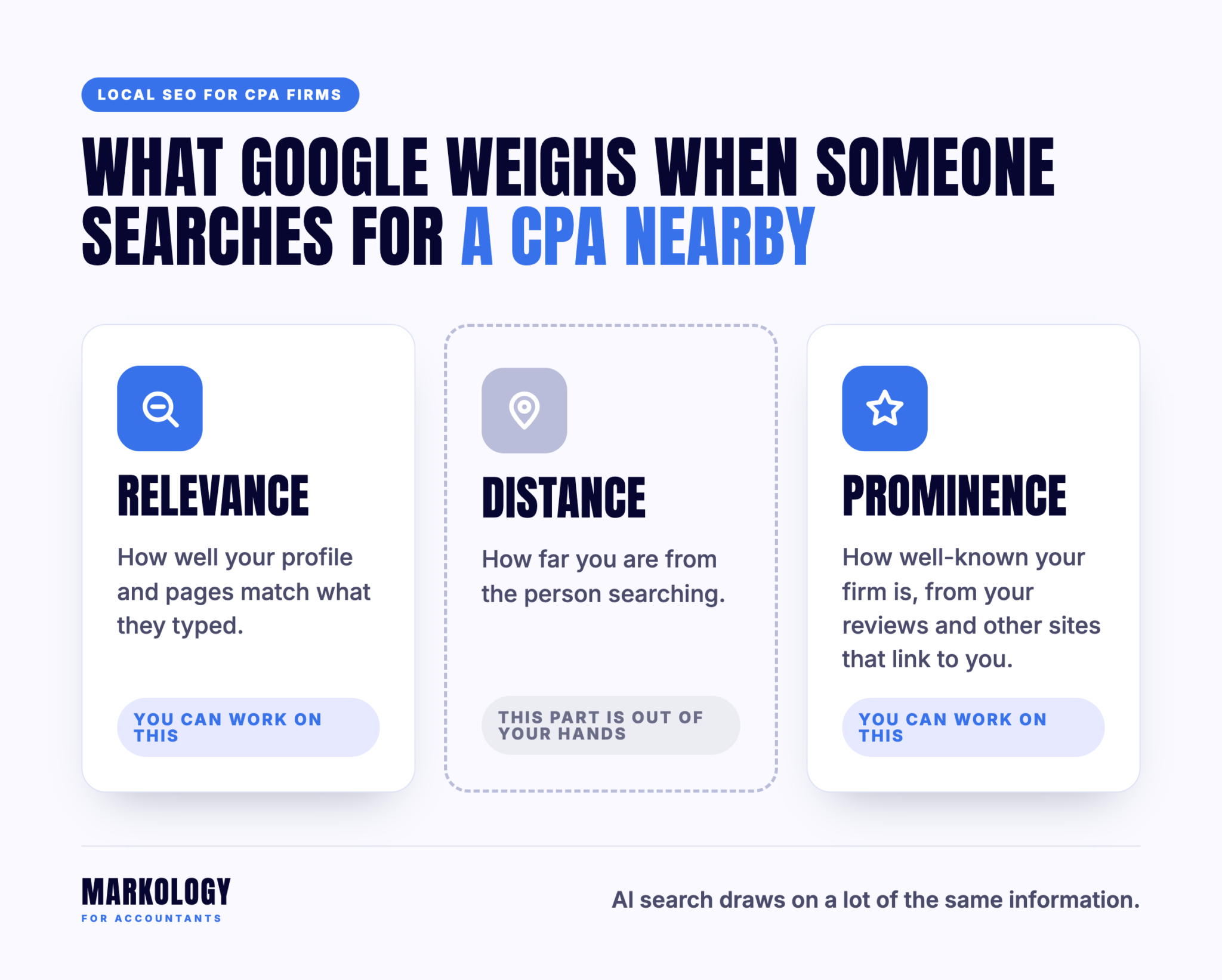
Google’s local results come down to three main things, which are relevance, distance and prominence.
Relevance is how well your profile matches what the person typed, so complete details and clear pages help. Distance is how far you are from the person searching, and that part is out of your hands. Prominence is how well-known your firm is, which Google judges partly from your reviews and from how many other websites link to you.
AI search draws on some of the same information, like your listings, your reviews and other sites that mention your firm. If you’re still deciding whether to focus on your own town or the suburbs around it, we wrote about how we think about local SEO for accountants. Wherever you focus, most of the relevance work starts with your Google Business Profile.
Start With a Google Business Profile That’s Complete and Correct
Your Google Business Profile is the listing that shows up on Google Maps and in the local results, with your hours, phone number, photos and reviews.
If clients come to an office with your sign on it and your team there during opening hours, the profile shows that address. If you only visit clients at their place, Google asks you to hide the address and list the areas you serve instead. Then choose the category that fits your firm best and list the services you actually want to be hired for. Add real photos of your team and office too, because people want to see who they’d be handing their finances to.
Check it again every so often, because Google adds services to profiles on its own based on user feedback, and not all of them are accurate. When we audited one firm’s profile, we found services listed that the firm didn’t offer and didn’t want to be known for.
Make Your Details Match Everywhere You’re Listed
Apple Maps, Bing, Yelp, navigation apps and the directories that feed them all carry your name, address and phone number, and these listings are called citations. When they disagree, people can end up calling an old number, and Google and AI search tools get mixed signals about which details are right.
During one round of citation work, we found that the phone number on a firm’s Google Business Profile didn’t match its other listings. Another firm’s Yelp page had been marked closed, and the login belonged to a former employee, so the owner couldn’t fix it for a long stretch.
Yelp is worth a look now that ChatGPT can use Yelp’s reviews, and we covered what accounting firms should check on Yelp separately. Here’s where we’d look first:
| Where to look | What to check | Why it matters to higher-value clients |
|---|---|---|
| Google Business Profile | Address, category, photos and any services Google added | It’s often the first thing they see about your firm |
| Other listings (Apple Maps, Bing, Yelp) | Name, address, phone and hours all match | Mixed details can send people to an old number or address |
| Google reviews | A steady flow of recent, real reviews | Reviews do the vouching a referral would have done |
| Your website | Your town and the people you help on each service page | It shows you’re nearby and you understand their business |
Why Do Reviews Matter So Much to Higher-Value Clients?
A referral works because someone the prospect trusts is telling them to go to you. When someone finds you through Google or ChatGPT instead, there’s often nobody vouching for you, so your reviews have to do it.
People really do read them. A client of one accounting firm we work with left a Google review, and later Google sent them a note saying how many people had viewed it. It was a lot more than the firm expected.
Google is fine with you asking clients for reviews, but offering a discount or a gift in exchange for one isn’t allowed. Yelp is stricter and asks businesses not to request reviews at all, so a review push that’s fine on Google carries a different risk on Yelp.
Reviews can also work against you. We watched one firm that had great reviews and a strong January for leads, and then the owner sold. The reviews slipped soon after the sale, and the following January brought in far fewer leads. Marketing amplifies what’s already there, so it’s worth watching your reviews as closely as your leads.
Ask When the Relationship Is at Its Peak
We like to ask for a review right after the work is finished, while it’s fresh for the client. In tax season that moment can slip by, because everyone is busy.
One firm we work with mails finished work back to its clients, so we suggested a small card in the envelope. The card asks how they felt about the service and ends with a link to leave a Google review, and it arrives just as they open the work you did for them. If you also want referrals, put that on a separate card, because the review ask is for everyone and a referral offer is only for the clients who send people your way.

Your Website Has to Say Where You Are and Who You Help
A complete profile gets people to your site, and then the site has to finish the job. If the page they land on says “your trusted advisor” and nothing about your town, it could belong to any firm anywhere.
Start with your homepage and your main service pages, and name your town on each one. You usually don’t need a separate page for “CPA near me.” Google already knows where the searcher is, so a tax page written for your town can show up for that search. If you serve nearby suburbs, we usually pick three or four to lead with and add more once those bring in traffic.
Then say who you help. A business owner wants to see that you understand their industry, so name the industries you work with on your service pages. Our SEO for accountants work covers those pages, and every website for accountants we build starts with this kind of copy.

How Long Does Local SEO Take to Bring In Clients?
With local firms, we usually start to see traction around the six-month mark with SEO, and national pushes closer to a year. We go through what speeds that up or slows it down in our post on how long accounting firm SEO takes.
You tend to notice when it starts working. One local firm we work with went into the new year in a much stronger spot on Google than the year before. Leads came in without any ads behind them, including one from Reddit, and by tax season the firm was booking three to four weeks out.
If you’d like us to handle it, our Markology Local plan covers local SEO, your Business Profile, location pages, local Google Ads and review generation for $2,199 a month, month to month. The details are on our pricing page.
Frequently Asked Questions About Local SEO for CPAs
Can my firm show up in a nearby city where we don’t have an office?
Your website can still show up for searches about a nearby town you serve. Showing up on Google Maps there is much harder without an office, because distance is one of the three things Google weighs. A co-working office can count if it has your sign, you see clients there and your own staff are there during business hours.
How many Google reviews does an accounting firm need?
There isn’t an official number, but we tell firms that twenty is a solid starting point, and you can grow from there. Ask clients and other people who have really worked with you, and skip anyone whose relationship with you would make the review look biased, like family or staff.
Does local SEO help my firm show up in ChatGPT?
It can, because AI tools pull from your listings, your reviews and other websites that mention you. Accurate listings and a steady flow of reviews give them better information about your firm on Google and in AI search, although nothing guarantees a recommendation. We cover the AI side on our GEO for accountants page.
Start by Reading Your Profile the Way a New Client Would
If you only do one thing this week, open your Google Business Profile and read it the way a stranger would. Check the phone number, the hours, the photos and the services, and take out anything Google added that you don’t offer.
We wrote more about picking the right towns in our post on local SEO for accountants.
If you’d like us to look through your profile and your site with you, you can book a call with us here.
Until next time!