What CPA in Digital Marketing Tells You About Your Ads
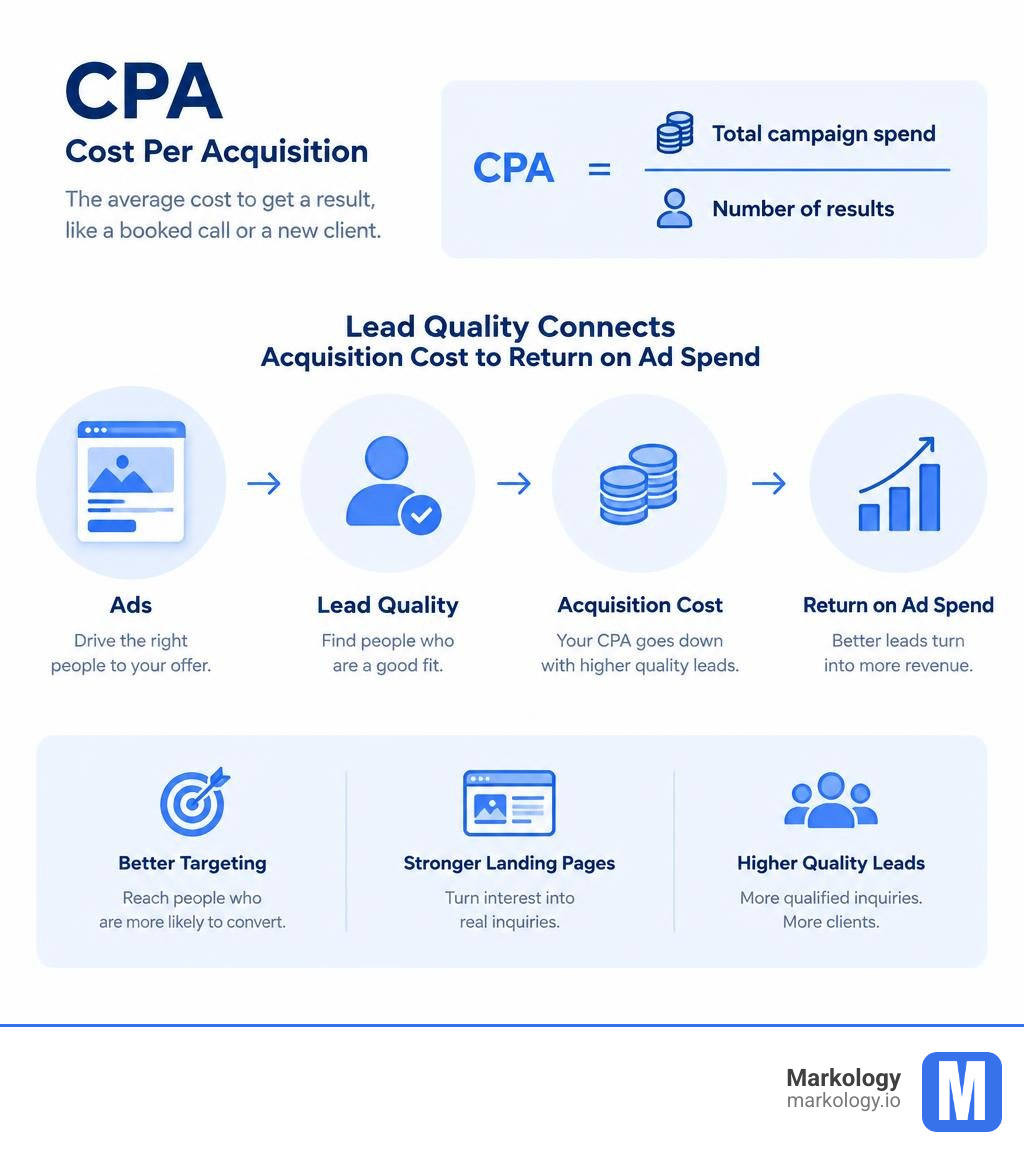
Your cpa in digital marketing is the average cost of getting a result you choose to track, such as a booked call or a new client. Divide your campaign spend by the number of those results to calculate it. To lower CPA, improve your ads and landing page, then check whether the inquiries are a good fit. A cheaper lead does not help if they never become a client.
I’m Whitney H., founder of Markology, and I’ve spent over 13 years working in marketing, including paid advertising, across the U.S., Australia, and Singapore. I use cpa in digital marketing to help accounting firms focus on qualified inquiries rather than clicks alone.
What Is CPA in Digital Marketing and How Does It Work?
In performance advertising, traffic is cheap to brag about but expensive to waste. Cost Per Acquisition (CPA) is the financial North Star that keeps marketing grounded in reality. Rather than measuring how many people scrolled past an image or clicked a link out of mild curiosity, CPA calculates the exact financial investment required to drive a meaningful commercial action.
When you configure conversion tracking on platforms like Google Ads, Meta, or TikTok, you establish distinct conversion goals. These milestones represent key points of progression in your sales funnel:
- A finalized checkout on an e-commerce catalog
- A submitted consultation request on a service page
- A completed registration for a webinar or gated resource
- An activated software trial or app installation
Every time an ad impression converts a passive reader into an active participant, tracking pixels and analytics tools register that success. By weighing the total capital poured into the campaign against those completed outcomes, you reveal the true cost of business growth.
Cost Per Acquisition vs. Cost Per Action
Marketers frequently use “Cost Per Acquisition” and “Cost Per Action” interchangeably, but there is a slight functional distinction depending on the stage of the funnel you are evaluating.
- Cost Per Acquisition: This metric typically refers to macro-conversions, specifically the acquisition of a paying client or registered customer. It represents revenue-generating closure.
- Cost Per Action: This broader metric encompasses micro-conversions, such as downloading an informational checklist, subscribing to a monthly newsletter, or submitting a contact form.
Understanding this difference is critical when setting up campaigns. As outlined in the official Google Ads documentation on the definition of cost per action, the action tracked dictates how smart bidding algorithms optimize your budget. If you optimize for low-barrier micro-actions, your reported CPA will look remarkably low, but those numbers will not translate into revenue unless your downstream sales process reliably nurtures those participants into paying accounts.
Step-by-Step Formula: How to Calculate CPA in Digital Marketing
At its core, calculating CPA requires simple arithmetic, but calculating true acquisition cost requires honest accounting.

The basic mathematical formula is:
CPA = Total Campaign Costs / Number of Completed Conversions
Let’s look at a practical example:
Suppose an online boutique runs a targeted holiday ad campaign. Over 30 days, they invest $5,000 directly into paid media across Google and Meta. The campaign yields 100 finalized customer purchases.
CPA = $5,000 / 100 = $50 per customer
However, looking solely at ad spend often creates a false sense of profitability. A comprehensive, real-world CPA should factor in every variable that made the campaign run:
- Direct media spend: $8,000
- Creative production (photography, video editing, copy): $5,000
- Dedicated personnel or agency management fees: $3,000
- Software, hosting, and tracking overhead: $2,000
- Total campaign investment: $18,000
If this multi-channel campaign generates 150 confirmed sales, the true calculation is:
True CPA = $18,000 / 150 = $120 per customer
Accounting for these hidden costs ensures you never scale an ad set that looks profitable on an ad platform dashboard while quietly draining your bank account behind the scenes.
Comparing CPA to CPC, CPM, CPL, and ROAS
Digital advertising pricing models allocate financial risk differently between the advertiser and the ad network. Understanding how these models interact helps you select the right campaign objective for your current growth phase.
| Metric | Full Name | Charging Trigger | Financial Risk Placement | Best Used For |
|---|---|---|---|---|
| CPM | Cost Per Mille | Per 1,000 ad impressions | High advertiser risk | Top-of-funnel brand awareness and reach |
| CPC | Cost Per Click | Per user click on the ad | Shared risk | Driving mid-funnel website traffic |
| CPL | Cost Per Lead | Per inquiry or contact form | Low advertiser risk | Building prospect pipelines and email lists |
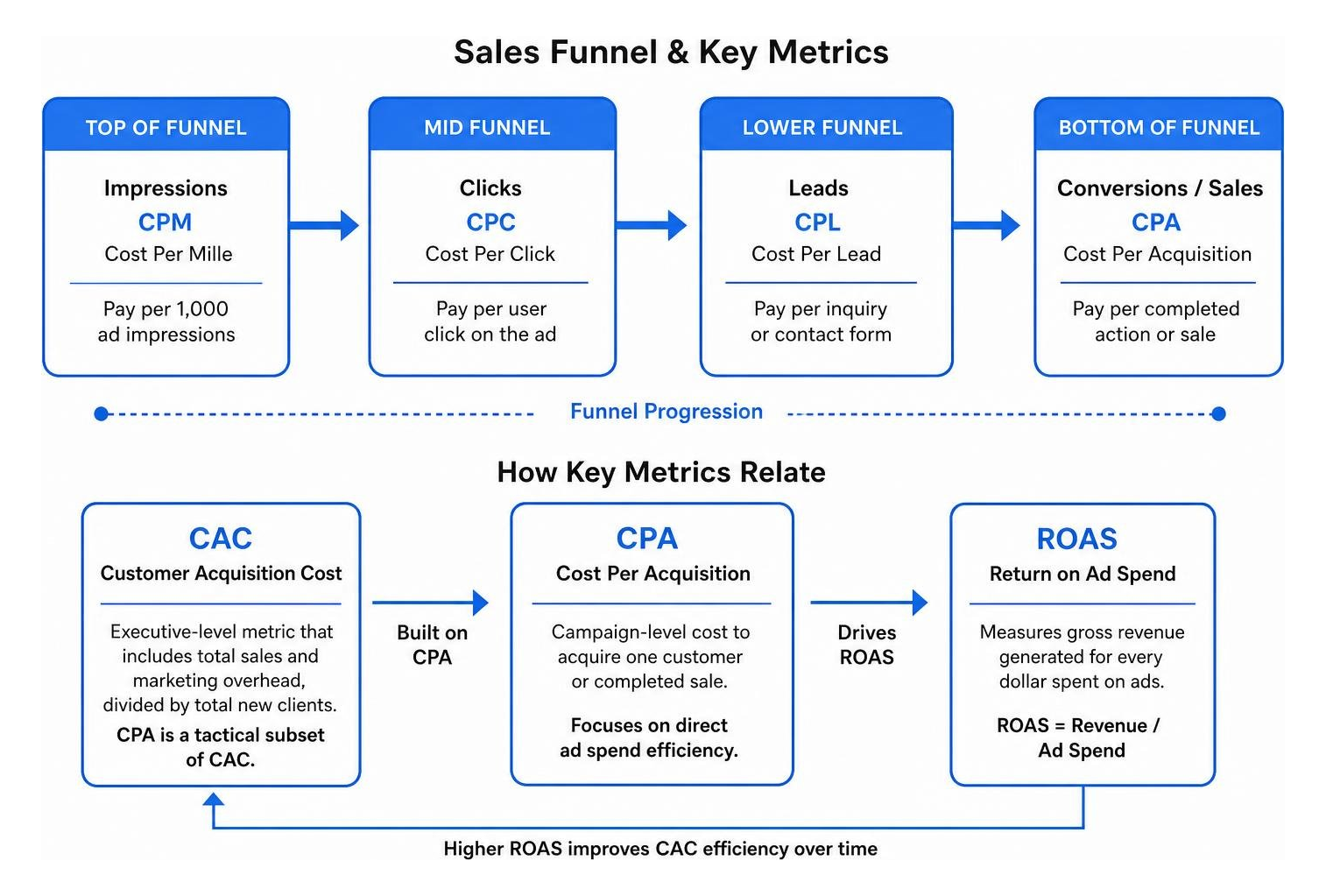
| CPA | Cost Per Acquisition | Per completed action or sale | Minimal advertiser risk | Bottom-of-funnel sales and direct client acquisition |
Ad auction dynamics determine how much you pay under each model. In CPM bidding, you pay simply for screen time, regardless of whether a human engages with the creative. In CPC models, ad networks reward high click-through rates (CTR) by lowering click prices. In CPA models, the advertiser only pays when the transaction completes, shifting the bulk of performance risk onto the platform or publisher.
For a deeper dive into these auction models, review HubSpot’s expert guide on cost per acquisition to see how quality scores influence final bid rank.
CPA vs. CPL, CAC, and ROAS
Confusing these related performance metrics leads to flawed executive reporting:
- Cost Per Lead (CPL): Measures what it costs to acquire contact information from a prospective buyer. A prospect who fills out a form is an opportunity, not revenue.
- Customer Acquisition Cost (CAC): An executive-level metric that incorporates your entire organizational sales and marketing overhead (including enterprise sales reps, CRM tools, and overhead salaries) over a quarter or fiscal year, divided by total new clients. CPA is a tactical, campaign-specific subset of broader CAC.
- Return on Ad Spend (ROAS): Measures gross revenue generated for every dollar spent on ads (Revenue / Ad Spend). While CPA tells you how much it costs to win a conversion in pure dollars, ROAS tells you the financial return multiple on that investment.
Advantages and Disadvantages of the CPA Pricing Model
The CPA model is exceptionally popular among direct-response advertisers, but it presents trade-offs for both parties.
Advantages for Advertisers:
- Capital Protection: You primarily pay for tangible, bottom-line results rather than empty website traffic.
- Predictable Forecasting: Budget scaling becomes straightforward once your unit economics and acquisition rates stabilize.
- Goal Alignment: Ad platforms utilize machine learning to seek out high-intent buyers rather than casual window shoppers.
Disadvantages and Publisher Risks:
- Attribution Complexities: Modern multi-device journeys, privacy updates, and browser cookie restrictions can make direct attribution difficult.
- Higher Base Costs: Because networks assume conversion risk, inventory sold on pure CPA or target-action structures commands higher baseline bid rates than raw impression inventory.
- Publisher Resistance: Media networks will quickly deprioritize your ads if your landing page converts poorly, as sending you traffic that fails to convert yields zero revenue for their platform.
What Is a Good CPA? Industry Benchmarks and Unit Economics
A “good” CPA is completely relative to your gross profit margins, average transaction size, and client retention rates. A $100 CPA is disastrous for an online store selling $30 sunglasses, but extraordinarily lucrative for an accounting firm securing a $5,000 annual corporate tax client.
Platform and Vertical Benchmarks in 2026
Acquisition costs fluctuate significantly based on audience purchase intent, platform ad formats, and competitive bidding density.
| Industry Vertical | Average CPA Range | Top Platform Dynamics | Key Cost Driver |
|---|---|---|---|
| E-commerce | $20 – $65 | Meta: $11.14 (sales) / TikTok: $1.14 (TikTok Shop) | Cart abandonment and impulse checkout friction |
| SaaS & Tech | $40 – $150 | Google Search ($48.96 avg) / LinkedIn Ads | High competitive bidding on high-intent software keywords |
| Real Estate | $30 – $215 | Meta Lead Forms / Google Local Search | Local geographic targeting and long sales cycles |
| Travel & Hospitality | $7 – $60 | Meta Display ($18.68 avg) / Google Display ($75.51 avg) | Seasonal travel demand and discount promotions |
| Health & Wellness | $15 – $90 | TikTok Native Leads ($2.69) / Meta ($6.00) | Influencer endorsements and social proof |
| Finance & Accounting | $40 – $200 | Google Search / High-intent organic content | Stringent regulatory requirements and high client lifetime value |
Platform choices dictate your cost structure. In 2026 campaign data, short-form video channels like TikTok achieved remarkably low acquisition costs for native lead generation ($2.69) and direct product purchases ($1.14) due to integrated in-app checkout and autofill forms. Meanwhile, Meta maintained steady averages for lead acquisition ($6.00) and e-commerce conversions ($11.14), offering higher average order values and stronger downstream retention that balance out its higher initial price tag.
The 3:1 CLV-to-CPA Profitability Framework
To determine whether your marketing investment is financially sustainable, evaluate your numbers through the Customer Lifetime Value (CLV) to CPA framework.
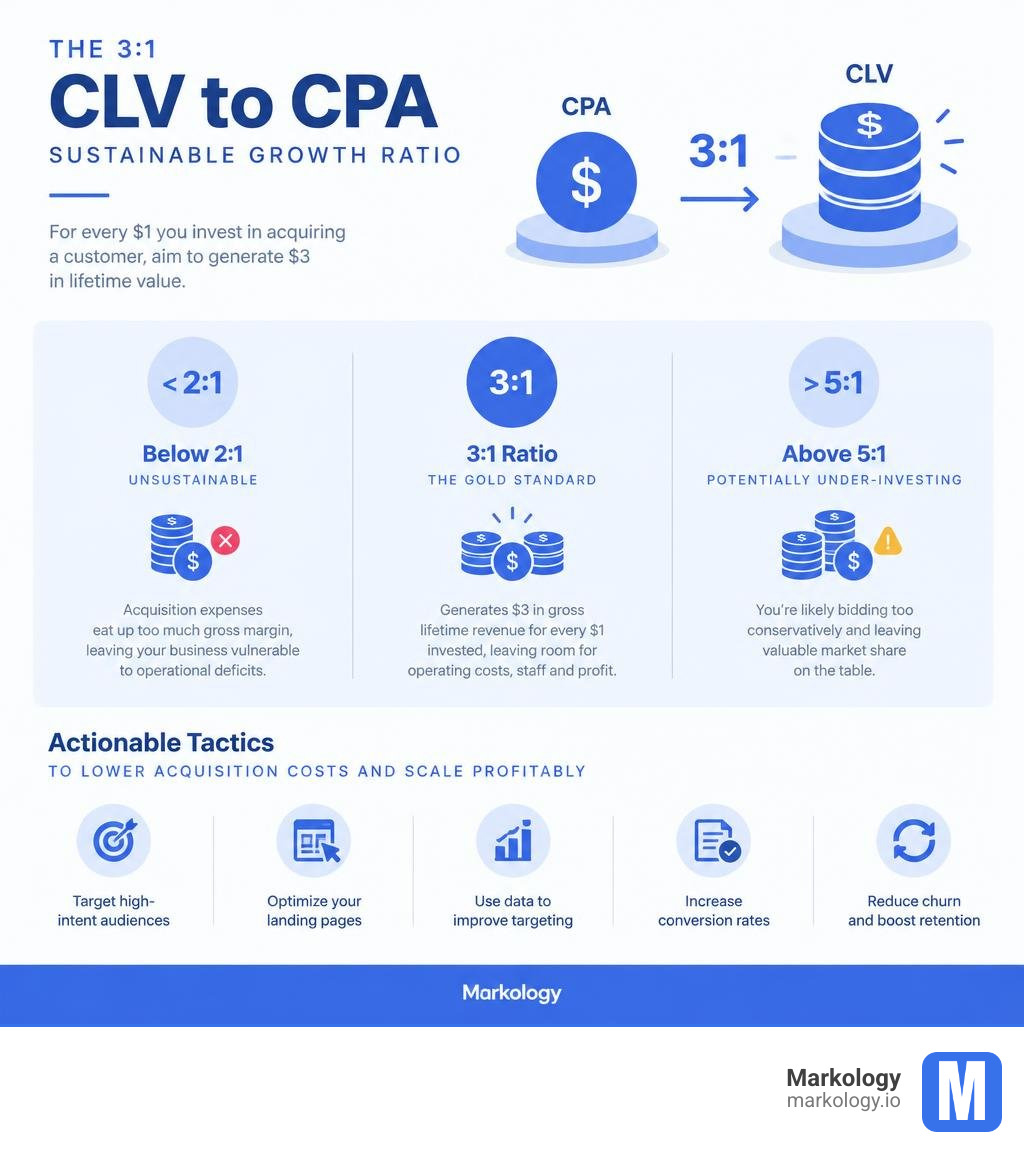
- Below 2:1 Ratio: Unsustainable. Acquisition expenses eat up too much gross margin, leaving your business vulnerable to operational deficits.
- 3:1 Ratio: The healthy gold standard. For every $1 invested in acquiring a customer, you generate roughly $3 in gross lifetime revenue. This leaves adequate margin for operating costs, staff overhead, and net profit.
- Above 5:1 Ratio: Highly efficient, but potentially a sign of under-investment. If your ratio is exceptionally high, you are likely bidding too conservatively and leaving valuable market share on the table.
Actionable Tactics to Lower Acquisition Costs and Scale Profitably
Lowering your CPA requires systematic optimization across two primary levers: your ad account’s front-end targeting and your website’s back-end conversion pipeline.
Creative and Targeting Tactics to Reduce CPA in Digital Marketing
- Establish a High-Velocity A/B Testing Pipeline: Ad creative is the primary lever for controlling paid social costs. Plan creative refreshes every two to three weeks to prevent ad fatigue. Test contrasting hooks, real-world user-generated content (UGC), and plain-text graphics against polished studio designs.
- Build High-Value Lookalike Audiences: Instead of building lookalikes from general website visitors, export a segmented list of your top 20% highest-spending or longest-retained clients from your CRM. Train platform algorithms on your ideal client profile.
- Deploy Broad Targeting with Qualifying Hooks: Modern machine-learning algorithms on Meta and TikTok excel when given broad parameters. Instead of hyper-restricting audiences by interest tags, let your creative qualify the viewer. State clearly in the first three seconds who your offer is for—and who it is not for—allowing the algorithm to find qualified prospects at scale.
- Implement Tight Retargeting Windows: Retarget website visitors who abandoned forms or checkouts within a tight 7-to-14-day window. These warm prospects convert at significantly higher rates, lowering your blended acquisition cost.
- Prune Negative Keywords Weekly: In Google Search campaigns, review your search term reports weekly. Add negative keywords for low-intent search terms (e.g., “free,” “jobs,” “templates,” “DIY”) to prevent wasting ad budget on clicks that will never convert.
Landing Page and Conversion Funnel Optimization
Your ads can only bring qualified traffic to your door; your website must close the deal. An optimized landing page can lift baseline conversion rates by 300% or more, cutting your CPA in half without increasing ad spend by a single penny.
- Eliminate Checkout and Form Friction: Cart abandonment hovers around 70% across the web, with unexpected charges, hidden fees, and mandatory account creation cited as top reasons for drop-off. Introduce express payment options (Apple Pay, Shop Pay) and strip non-essential fields from lead forms.
- Ensure Strict Message Match: If your ad headline promises a “Fixed-Fee Corporate Tax Audit Assessment,” your landing page headline must match that exact phrasing. Inconsistencies confuse visitors and drive immediate bounces.
- Optimize Mobile Page Speed: Every second of delay in mobile load times degrades conversion efficiency. Compress hero images, eliminate render-blocking scripts, and keep user navigation straightforward.
- Support Paid Ads with Organic Authority: Paid ads convert at higher rates when prospects validate your brand through authoritative organic content. Combining search ad campaigns with dedicated search engine optimization strategies and informative content marketing campaigns establishes long-term credibility that lifts overall conversion velocity.
Frequently Asked Questions About CPA
Why is my CPA increasing over time?
A rising CPA typically indicates ad fatigue, creative burnout, or audience saturation. When the same audience sees your ad creative too many times, click-through rates decline and impression costs rise. High CPA can also stem from unoptimized landing pages, technical tracking glitches, or aggressive competitor bidding driving up auction CPMs during peak seasonal periods.
Can an acquisition cost be too low?
Yes. An unusually low CPA is sometimes a red flag. If your cost per conversion drops dramatically, check your tracking configuration to ensure you aren’t accidentally counting page views or secondary button clicks as sales. Furthermore, optimizing purely for the cheapest possible form submissions often floods your sales pipeline with unqualified leads who lack the budget to buy your core services.
How does Target CPA bidding work in paid search?
Target CPA (tCPA) is an automated bidding strategy that uses machine learning to evaluate historical conversion data and user auction signals (device, location, time of day, browser history). It automatically adjusts individual keyword bids in real time to capture conversions near your target threshold. For reliable results, Google recommends that a campaign achieve a minimum volume of 30 to 50 conversions per month so the algorithm has sufficient data to optimize effectively.
Conclusion
Understanding and controlling your cost per acquisition is the cornerstone of sustainable digital growth. When you measure true costs, respect your unit economics, and continually refine both your advertising creative and landing page experiences, you turn unpredictable marketing spend into a reliable, revenue-generating engine.
If you run a specialized accounting or advisory practice and want to streamline your client acquisition without wasting budget on empty clicks, partner with an experienced digital marketing agency for accountants. At Markology, we combine over a decade of performance marketing experience with specialized industry insight to help your firm attract qualified, high-value clients profitably.